
Rio Grande Valley schools are doing well on measles shots.
That is the plain finding in new state data. The Texas Department of State Health Services just put out its school year 2025-2026 report. It counts how many kindergartners got each required shot. It also lists the numbers by county and by school district.
El Tejano pulled the state files and read the Valley rows.
Here is what they say.
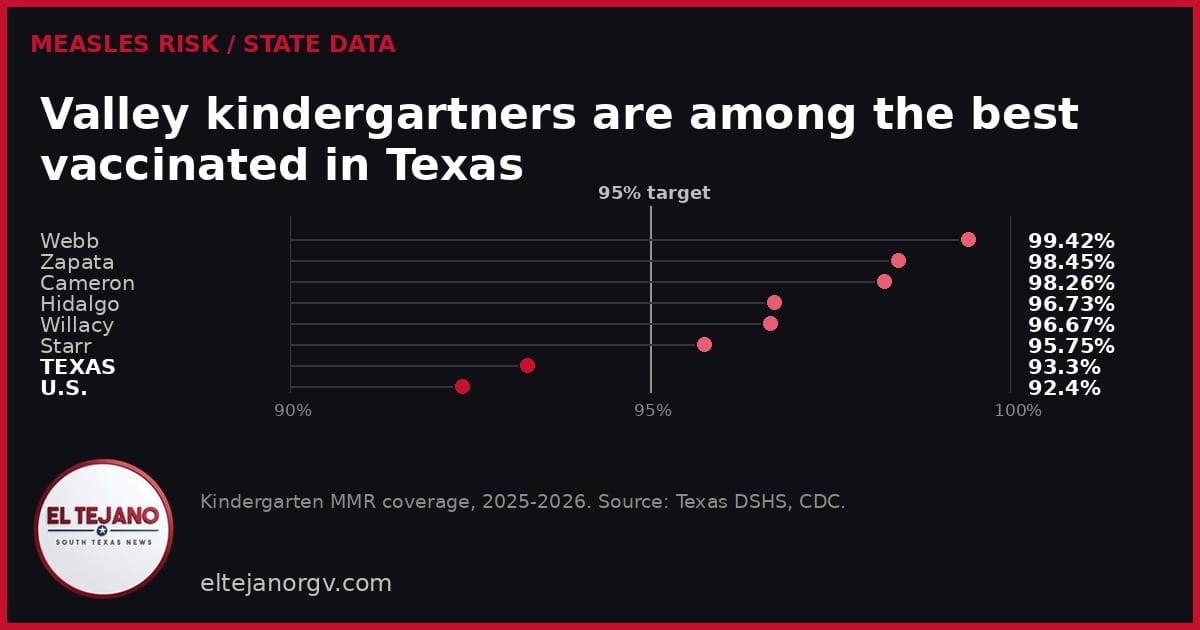
Webb County led the area. In Webb, 99.42 percent of kindergartners were fully vaccinated for MMR. That is the measles, mumps and rubella shot. Cameron County came in at 98.26 percent. Hidalgo County was 96.73 percent. Starr County was 95.75 percent.
Nearby counties did well too. Zapata County was 98.45 percent. Willacy County was 96.67 percent. Jim Hogg County was 93.22 percent.
Now compare that to the rest of Texas.
Statewide, 93.30 percent of kindergartners were fully vaccinated for MMR. That number covers public and private schools together. In public schools alone it was 93.57 percent.
So four of the biggest Valley counties sit above the state number. Starr County is more than two points above it. Webb County is about six points above it.
The Valley also beats the country. The Centers for Disease Control and Prevention says the national rate for the same school year was 92.4 percent.
The 95 percent line
Public health agencies use 95 percent as the goal for measles. The CDC ties it to a federal target called Healthy People 2030. The idea is simple. Measles spreads fast. When almost everybody in a school is protected, the virus runs out of people to infect.
Texas as a whole is not at that line. Neither is the country.
But Starr, Hidalgo, Cameron and Webb all are.
Starr County is the one that moved. A year earlier, in 2024-2025, Starr County kindergartners were at 94.58 percent for MMR. This year they hit 95.75 percent. That is a gain of about 1.2 points, by El Tejano's math. It carried the county over the 95 percent mark.
Cameron and Webb held steady. Cameron went from 98.17 percent to 98.26 percent. Webb stayed at 99.42 percent. Hidalgo slipped a little, from 96.88 percent to 96.73 percent.
The state also groups counties into health regions. The Valley falls in Region 11, which the health department runs out of Harlingen. Region 11 kindergartners hit 97.20 percent for MMR. El Tejano compared all eight regions in the state report. Region 11 was the highest.
Find your own district
The state posts the numbers school district by school district. Here is the MMR rate for Valley public districts, for kindergartners in 2025-2026.
In Starr County: San Isidro ISD 100 percent, Roma ISD 96.87 percent, Rio Grande City Grulla ISD 95.05 percent.
In Webb County: Laredo ISD 99.52 percent, United ISD 99.38 percent, Webb CISD 90 percent.
In Hidalgo County: Valley View ISD 100 percent, Mission CISD 99.75 percent, Mercedes ISD 99.50 percent, Donna ISD 99.45 percent. Then Weslaco ISD 98.62 percent, Hidalgo ISD 98.58 percent, Pharr-San Juan-Alamo ISD 98.48 percent, Edcouch-Elsa ISD 97.65 percent. Then Progreso ISD 96.97 percent, Sharyland ISD 96.88 percent, McAllen ISD 96.57 percent. Then Edinburg CISD 94.41 percent, La Joya ISD 93.63 percent, La Villa ISD 87.50 percent.
In Cameron County: Santa Maria ISD 100 percent, San Benito CISD 99.24 percent, Rio Hondo ISD 98.82 percent. Then Los Fresnos CISD 98.63 percent, Brownsville ISD 98.46 percent, La Feria ISD 98 percent. Then Harlingen CISD 97.89 percent, Point Isabel ISD 97.32 percent, Santa Rosa ISD 95.24 percent.
In Willacy County: Lasara ISD and San Perlita ISD both 100 percent, Raymondville ISD 99.15 percent, Lyford CISD 92.39 percent.
Zapata County ISD was 98.45 percent. Jim Hogg County ISD was 93.22 percent.
The districts below the line
A few Valley districts fell under 95 percent. They should be named, and here they are.
Edinburg CISD was 94.41 percent. La Joya ISD was 93.63 percent. Jim Hogg County ISD was 93.22 percent. Lyford CISD was 92.39 percent. Webb CISD was 90 percent. La Villa ISD was 87.50 percent.
Two of those need a caveat. Webb CISD and La Villa ISD are very small districts. In a district with only a handful of kindergartners, one child changes the rate by a lot. Both were at 100 percent the year before. The state file also leaves out any school with five or fewer kindergartners.
Some private schools were much lower. Macedonian Christian Academy in Hidalgo County reported 38.89 percent. Covenant Christian Academy reported 64.10 percent. South Texas Christian Academy reported 73.33 percent. St. Alban's Episcopal School in Harlingen reported 80 percent.
Other Valley private schools were at 100 percent. Those include Our Lady of Sorrows School, San Martin De Porres Catholic School, St. Joseph Catholic School in Edinburg, St. Mary's Catholic School in Brownsville and St. Anthony Catholic School in Harlingen. Four private schools in Laredo also reported 100 percent.
Very few Valley parents opt out
Texas lets a parent skip required shots for reasons of conscience. That includes religious belief. The state counts how many families do it.
Across Texas, 155,710 students from kindergarten through 12th grade had one of these exemptions on file. That is 2.95 percent of the 5,285,589 students in the report.
Valley districts are far below that.
Roma ISD reported 0.02 percent. Raymondville ISD reported 0.05 percent. Valley View ISD reported 0.16 percent. Edcouch-Elsa ISD reported 0.17 percent. Weslaco ISD reported 0.20 percent. Four more each reported 0.23 percent. Those were Laredo ISD, Hidalgo ISD, Mercedes ISD and Mission CISD. San Benito CISD reported 0.29 percent. Donna ISD reported 0.31 percent. La Joya ISD reported 0.37 percent. Brownsville ISD reported 0.38 percent. Rio Grande City Grulla ISD reported 0.43 percent.
Four districts reported zero. Those were Webb CISD, La Villa ISD, Progreso ISD and Jim Hogg County ISD. None of the four had a single conscientious exemption on file.
The highest Valley public districts were still low. McAllen ISD was 1.70 percent. Edinburg CISD was 1.68 percent. Rio Hondo ISD was 1.69 percent. All three sit under the state figure.
The measles picture right now
Texas has measles cases this year. The Valley does not.
State health officials counted 191 confirmed cases in Texas residents in 2026. That count runs through September 4. The state calls the number provisional, which means it can change.
Most of those cases are in one place. Hudspeth County, out in far West Texas, had 136. El Paso County had 24. The state notes that some of those cases are people held in federal detention facilities.
The rest were spread thin. Harris County had 7. Rockwall County had 6. Bandera County had 5. Montgomery County had 4. Frio County had 2. Bexar, Dallas, Kendall, Lubbock, Potter, Travis and Upshur counties each had 1.
Starr, Hidalgo, Cameron and Webb counties are not on the state list.
Nationally, the picture is bigger. The CDC counted 3,134 confirmed measles cases in the United States in 2026, as of September 3. Cases came from 47 places. There were 38 new outbreaks. About 95 percent of cases were tied to an outbreak, which works out to 2,969 of the 3,134.
For all of 2025, the country had 2,289 cases. So 2026 is already worse.
The CDC says no measles deaths have been recorded in the United States in 2026. Federal health statisticians have no 2026 death record listing measles as the cause.
How measles spreads
Measles moves through the air.
A sick person coughs, sneezes or talks. The virus goes into the air. It can hang there for up to two hours. You can walk into an empty room and still catch it.
State health officials put it bluntly. If a person has measles, about 90 percent of the people near them who are not immune will get it.
A person spreads measles before they even look sick. They are contagious about four days before the rash shows up. They stay contagious about four days after.
The rash usually shows up about 14 days after exposure. Before that come fever, cough, runny nose, red eyes and sore throat. Some people get blue-white spots inside the mouth. The rash starts at the hairline and moves down. Fever can go over 104 degrees.
Measles is not just a rash. It can cause ear infections and diarrhea. It can also cause pneumonia and swelling of the brain. It can kill.
The highest risk goes to children under 5, adults over 20, pregnant women and people with weak immune systems.
The shot and the schedule
The MMR shot protects against measles, mumps and rubella.
Children get two doses. The first comes at 12 to 15 months old. The second comes at 4 to 6 years old.
Two doses stop about 97 percent of measles infections. One dose stops about 93 percent. For most people the protection lasts for life.
There is also a shot called MMRV. It adds chickenpox. It is for children 12 months through 12 years old.
Babies who travel abroad get a special rule. An infant 6 to 11 months old should get one dose before the trip. Then they still need the two regular doses after their first birthday.
Where to get it in Texas
Texas has programs for families who cannot pay.
Texas Vaccines for Children covers every Texas child, no matter what a parent can afford. The Adult Safety Net program covers people 19 and older with no health insurance.
Pharmacists can give the shot too. For children 13 and under, the pharmacist needs a prescription from a doctor. For children 14 and up, no prescription is needed.
What a conscientious exemption is
Texas law says students must get certain shots to attend school. Those include measles, mumps and rubella.
There are three ways out. A doctor can say a shot is not safe for that child. The student can be on active duty in the military. Or the family can object for reasons of conscience, including religious belief.
The medical version needs a note from an MD or a DO. Schools have to accept it. The note is good for one year, unless the doctor says the condition is lifelong.
The conscience version works differently. It uses a state affidavit.
Here is how a parent files one.
The health department now posts a blank affidavit online. It is stock number F11-11755. A parent can download it and print it. A parent can also ask the state to mail a copy. Requests go by mail, by fax, online or in person. The state does not take requests by phone or email. Mailed forms take about three weeks.
The form has to be notarized. It cannot be changed in any way. The parent fills in the student's name, signs it and gets it notarized. Then the parent turns it in to the school or child care center.
The exemption is good for two years from the date the notary signs it.
One catch matters. A school or a health department can keep an unvaccinated child home during a declared outbreak or emergency.
About the numbers
The state report is a survey. Districts and private schools fill it out themselves and send it in.
For 2025-2026, the state sent the survey to 6,176 schools and districts. About 87.70 percent answered. Public districts answered at 96.51 percent. Private schools answered at 78.25 percent.
The district file leaves out any school with five or fewer kindergartners. So the smallest campuses do not appear.
El Tejano took the county, district and statewide figures straight from the state files. The year to year changes in this story are El Tejano's own math, done from the state's published rates.