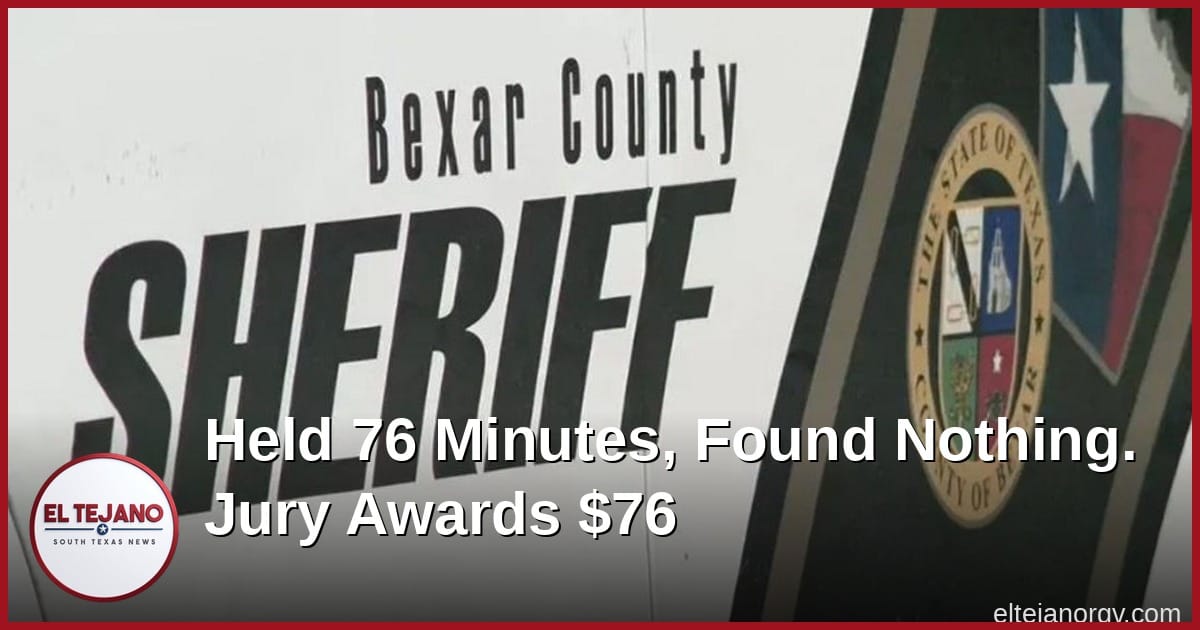
A federal jury in San Antonio ruled against Bexar County. The case was over a traffic stop on I-35. The jury gave the driver $76. That is $1 for each minute deputies kept him on the side of the road.
The verdict came Monday, Sept. 28. The driver is Alek Schott, a Houston-area father of two. He sells gear for his family's oilfield business. His lawyers say the jury found the county broke his rights under the Fourth Amendment. That part of the Constitution bans unreasonable searches and seizures.
This case matters to anyone who drives from the border to San Antonio. His lawyers say cameras that read plates flagged his trip to the border and back. The deputy believed the tip came from a man who worked in Laredo, his lawyers say.
The stop happened in March 2022. Schott had driven to a well pad outside Carrizo Springs for work, his lawyers say. He spent the night at a hotel nearby. He was on his way home on I-35 when Bexar County Deputy Joel Babb pulled him over.
Babb said the truck drifted out of its lane. Schott sued in 2023. His lawsuit says his own dashcam and the deputy's body camera show that did not happen. His lawyers say the evidence at trial showed the same thing.
Babb had Schott sit in his patrol car and asked him a lot of questions, the lawsuit says. The lawsuit says Babb told Schott he did not "give a crap" about traffic violations. Babb asked if there was anything illegal in the truck. He asked if Schott had more than $10,000 in cash. Schott said no when the deputy asked to search the truck.
Babb kept his driver's license and called for a drug dog, the lawsuit says. The dog alerted on the truck. Schott's lawyers say the dog's handler cued the dog to do it. Deputies then searched the Ford F-250. They found nothing. Schott left with a warning.
Babb has given his own reasons for being suspicious. A federal judge's report from February lists them. When Babb asked about weapons, Schott said, "I don't think so. There shouldn't be." Babb testified that answer "raised a red flag." He also pointed to heavy breathing and trembling hands.
So why was Schott stopped in the first place? His lawyers say the tip reached the county through a WhatsApp group chat called the "Northwest Highway Group." Babb testified it came from a man he knew only as "Kiki." Babb believed Kiki worked at a federal fusion center in Laredo. A fusion center is an office where police agencies share tips and data.
His lawyers say cameras run by the federal government flagged his truck. Those cameras read license plates and log where cars go.
"After the stop, I filed a complaint with the Sheriff's Office because I knew what happened to me was wrong," Schott said in a statement put out by his lawyers. "The department reviewed it, told me they didn't see any violation, and said if I had a problem with it, I should sue them. So I did."
Schott sued under a federal civil rights law. That law lets people sue a local government when its policy or custom breaks their rights. His lawyers say they had to prove more than one bad stop. They had to show the Sheriff's Office had a custom of stopping and searching drivers this way. They also had to show the Sheriff knew or should have known, and that the practice caused what happened to Schott. The jury agreed, his lawyers say.
Schott asked for $76, and that is what the jury gave him. His lawyers work for the Institute for Justice, a public interest law firm. They have handled his case for free since 2023.
"Motorists across this country are being watched by local, state and federal agents, flagged by AI-powered cameras, and then pulled over for a bogus offense that exists only as a cover story for an interrogation and a search," said Christie Hebert, one of his lawyers. "The Fourth Amendment does not permit this."
Babb told Schott he was on a criminal interdiction unit, according to his lawyers. The lawsuit says that kind of unit uses traffic stops to look for bigger crimes, like drug smuggling. Cops sometimes stop a driver for a small thing to hunt for something bigger. That is called a pretext stop. Schott's lawyers say in his case there was no real traffic violation at all.
Schott's lawyers say this kind of stop went on in Bexar County for four years. They say many drivers who did nothing wrong went through the same thing.
The verdict is not the last step. Schott's lawyers say they will now ask the judge for an order. It would bar Bexar County from using baseless traffic stops to search cars without a warrant. The county can still ask the court to set the verdict aside or appeal.
The case is in federal court in San Antonio.