A Florida congressman went on national TV last month. He was asked about measles shots in his home state. He answered by blaming illegal immigration.
That claim lands hard on the Rio Grande Valley. So here are the case counts, straight from the agencies.
Here is what he said. Here is what the government's own numbers say.
What he said
U.S. Rep. Byron Donalds is a Republican from Florida. He is running for governor there. He spoke on a Sunday news show on August 23.
The interviewer noted that nearly all of Florida sits below a 95 percent shot rate for measles. The question was whether he tells parents to get their kids the shot.
Donalds answered this way, in his own words: "the reason why we have seen a measles outbreak in certain parts of the country is because of rampant illegal immigration into the United States from the previous administration."
He pointed to El Paso and to Southwest Florida. He said people who came in illegally "have not had that vaccination schedule."
The interviewer asked him a follow-up: "What evidence do you have of that?"
That is his statement. Now the numbers.
What the CDC counts
The Centers for Disease Control and Prevention counts measles cases all year. Its last count came on September 3.
The CDC listed 3,134 confirmed measles cases in the country this year. Of those, 3,118 came from 47 states and territories.
The CDC also counts cases in people visiting from other countries. That number is 16.
Sixteen. Out of 3,134.
The CDC says 38 new outbreaks started this year. It says 95 percent of cases are tied to an outbreak. That is 2,969 of the 3,134.
The CDC counts an outbreak as three or more linked cases.
The CDC page also explains how measles gets into the country. It says this: "Every year, measles is brought into the United States by travelers who get measles while they are in other countries."
The next line matters most. The CDC says: "These travelers are usually unvaccinated U.S. residents who travel internationally."
That is the CDC's own wording. Not a person crossing a river. A U.S. resident with no shot who flew somewhere and came home sick.
What Texas counts
Texas keeps its own count. The state health agency is the Department of State Health Services.
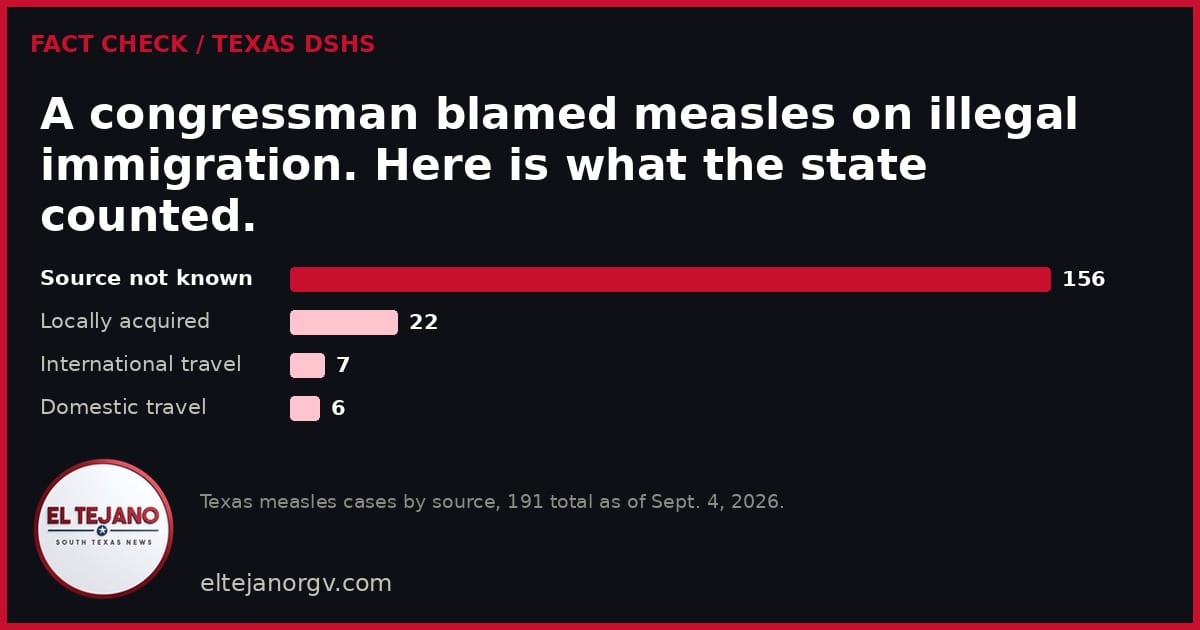
That agency posted its measles report on September 4. Texas had 191 confirmed cases this year.
The state sorts those cases by where they came from. Here is the whole list.
Locally acquired: 22 cases. Domestic travel: 6 cases. International travel: 7 cases. Unknown or other: 156 cases.
Seven. That is the state's count for international travel.
Read that list with care. Texas cannot sort 156 of the 191 cases. The state calls the data provisional. It can change.
The part of the claim that is real
Texas also breaks its cases down by county. Hudspeth County has 136 of them. El Paso County has 24.
The state adds one note under that table. It says: "A subset of confirmed cases are among individuals housed within federal detention facilities."
So yes. Some Texas cases are among people held in federal lockups out west. The state does not say how many.
That is the piece of the claim with something behind it. Here is the size of it.
Hudspeth County has 136 cases. The whole country has 3,134.
The number public health people watch
Health officials point to one number over and over. It is the share of kids with the measles shot.
The state health agency surveys Texas schools every fall. Its report for the 2025-2026 school year is out.
Statewide, 93.3 percent of Texas kindergarteners had the MMR shot. The report says coverage was "not above 95 percent for any vaccine."
Doctors use 95 percent as the line. Under it, measles spreads more easily.
Texas parents can opt out for reasons of conscience. For MMR, that rate was 4.63 percent.
Now the Valley.
The state lists every county. Cameron County kindergarteners hit 98.3 percent for MMR. Hidalgo County hit 96.7 percent. Willacy County hit 96.7 percent. Starr County hit 95.8 percent.
All four sit above the 95 percent line. All four beat the state.
Valley kids are better covered than Texas as a whole.
Hudspeth County, out west, was at 86 percent.
One more Texas outbreak
The state put out a health alert on July 28. It covered Montgomery County, near Houston.
Four people there got measles. None of the four had shots.
The state said how it started. The four had "exposure to a person with measles who traveled to Texas from another state."
Another state. Not another country.
What the evidence shows
Put the numbers next to each other.
The CDC: 3,134 cases, 16 in visitors from other countries. Texas: 191 cases, 7 tied to international travel. Texas kindergarten MMR: 93.3 percent, under the 95 percent line.
The CDC's own page says the travelers who bring measles home are usually U.S. residents with no shot.
The claim was that illegal immigration is the reason for the outbreak. The federal and state counts do not show that.
There is a real cluster among people in federal detention out in West Texas. It is 136 cases in one county. It is not the reason for 3,134 cases in 47 places.
What measles is
Measles is a virus. It is one of the easiest things on earth to catch.
The CDC says up to 9 out of 10 people near a sick person will catch it. That is for people with no protection.
It rides on the air. A cough or a sneeze puts it there.
The CDC says you can catch it just by walking into a room. The sick person can be gone up to two hours.
Signs show up 7 to 14 days after contact. A high fever comes first. The CDC says it can top 104 degrees.
Then a cough, a runny nose and red watery eyes. Then the rash.
Ear infections and diarrhea are common. Bad ones happen too. The CDC lists pneumonia, swelling of the brain, and death.
Kids under 5 face the most risk. So do adults over 20, pregnant women, and people with weak immune systems.
The shot
The MMR shot covers measles, mumps and rubella.
The CDC says the first dose goes at 12 to 15 months. The second goes at 4 to 6 years.
One dose is 93 percent effective against measles. Two doses are 97 percent.
The CDC says most people who get MMR are protected for life.
Babies 6 to 11 months who travel abroad should get one dose first. They still need two more after their first birthday.
Adults should have at least one dose on record. Some adults at higher risk need two.
Where to get the shot in the Valley
Cameron County Public Health runs shot clinics. It lists four.
The Mary P. Lucio Health Center is at 1204 Jose Colunga Jr. St. in Brownsville. The phone is 956-574-8745.
The San Benito Public Health Clinic is at 1390 W. Expressway 83. The phone is 956-361-8244.
The Harlingen Public Health Center is at 711 N. L St. The phone is 956-423-3516.
The Father Joseph O'Brien Health Clinic is at 142 Champion Ave in Port Isabel.
Cameron County lists who can go. People who qualify under Texas Vaccines for Children or the Adult Safety Net program. It says shots are given "regardless of a person's inability to pay."
Texas Vaccines for Children covers kids 18 and under. The Adult Safety Net covers uninsured adults 19 and up.
The state says the children's program gives Texas kids shots "regardless of parent's ability to pay."
The state also runs a phone line for shot questions. Cameron County lists it as 1-800-252-9152.
Families in other Valley counties can call that line. Hidalgo County's public web pages did not list clinic addresses or hours.
A note on the numbers
The CDC count runs through September 3. The Texas count runs through September 4. Both move week to week.
Texas calls its numbers provisional. They can change.
The CDC page carries one more line. It says the National Center for Health Statistics has no 2026 death records that name measles as the cause.