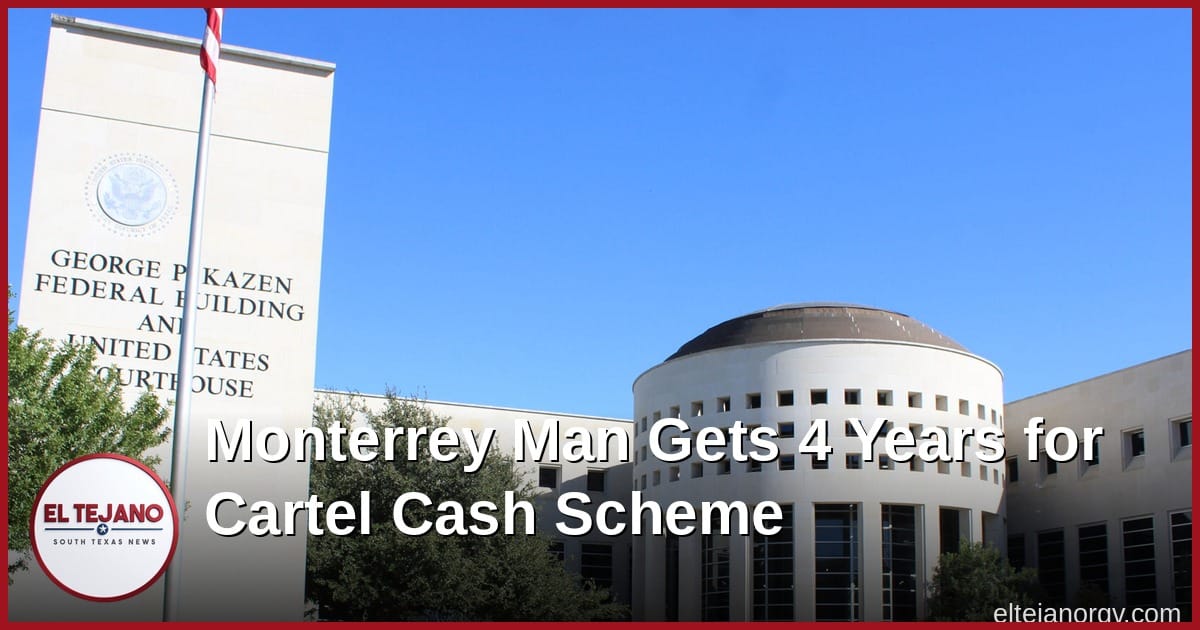
McAllen / Alamo, Texas -- Southern District of Texas
Three years. Two federal indictments. One staged traffic stop that ended in a shooting. A DEA sting at a mechanic shop in Alamo. And a man who, already under federal indictment in the first case, walked into the second one anyway.
On June 3, 2026, U.S. District Judge Drew B. Tipton sentenced defendants from two linked but legally distinct federal cases on the same afternoon in McAllen. What follows is a reconstruction of how both cases developed, what the court records actually show, and what still remains unresolved.
THE FIRST CASE: WHO GERARDO JAVIER OCHOA WAS
The foundation of everything here is Case 7:23-cr-00613, USA v. Ochoa et al, filed in the U.S. District Court for the Southern District of Texas, McAllen Division.
The FBI investigation traced back to at least 2022. By April 2023, agents had documented a cocaine distribution network operating in Hidalgo County. The man at its center was Gerardo Javier Ochoa.
When the federal grand jury returned the original sealed indictment in Case 7:23-cr-00613 on May 2, 2023, (Document 13 in the case docket), it did not treat Ochoa as a first-time offender. The indictment spelled out two prior drug felony convictions he carried into federal court:
First: a conviction in Hidalgo County's 370th Judicial District Court under Texas Health and Safety Code Section 481.112(c), Possession with Intent to Deliver a Controlled Substance, Cause Number CR-1749-09-G, for which Ochoa served more than 12 months.
Second: a conviction in the 139th Judicial District Court of Hidalgo County under Texas Health and Safety Code Section 481.115(f), Possession of a Controlled Substance, Cause Number CR-2430-10-C.
Those convictions carried direct legal consequences. Count One of the original sealed indictment charged Ochoa and co-defendant Jason Clemente Garces with a cocaine distribution conspiracy involving 500 grams or more, covering the period from January through April 12, 2023. It included a sentencing enhancement notice under 21 U.S.C. Section 851, filed by federal prosecutors to formally notify the court of Ochoa's prior felony drug conviction. Under that enhancement, a defendant convicted of a 500-gram cocaine conspiracy with a prior drug felony faces a mandatory minimum of 10 years before any upward factors are considered.
Count Two of the same indictment charged Ochoa alone with the April 12, 2023 cocaine possession charge and cited both of his prior convictions. Count Three charged Garces alone with a federal Hobbs Act robbery attempt under 18 U.S.C. Section 1951(a), alleging that between April 12 and April 17, 2023, he attempted to obstruct interstate commerce by robbery, specifically by trying to take drug proceeds from another person.
The original sealed indictment named three defendants in total: Ochoa, Garces, and Barbarito Gonzalez.
WHAT THE FBI DOCUMENTED: THE COCAINE SALE AND WHAT FOLLOWED
On April 12, 2023, FBI Special Agents documented Ochoa selling approximately 260 grams of cocaine to a person identified in court filings as "Individual 1" in McAllen. Agents had it on video and audio. They contacted Individual 1 later that same day.
Five days later, on April 16 into April 17, 2023, Individual 1 returned to an illegal gambling establishment in Hidalgo County. The FBI criminal complaint (Case 7:23-cr-00613, Document 1, filed May 1, 2023) places Ochoa at that location that night. So was Barbarito Gonzalez, a man who, according to court records, lived in Illinois but had entered the United States through a Port of Entry in April 2023. His red Chevrolet Silverado had been captured multiple times by license plate readers throughout the Rio Grande Valley in the weeks prior.
At approximately 2:00 a.m. on April 17, the Silverado pulled alongside Individual 1's BMW X5 while flashing red and blue lights, mimicking a law enforcement vehicle. The FBI affidavit characterizes it as a pseudo traffic stop. Individual 1 stopped.
Two men emerged from the Silverado and approached the BMW. When Individual 1 tried to drive away, both men opened fire. Individual 1 was struck by gunfire and transported to a local hospital.
The FBI affidavit documents the motive through intercepted communications. Around the time of the April 12 cocaine transaction, someone in the network had accused Individual 1 of stealing two kilograms of cocaine. Individual 1 had been told in a phone call that he would have to pay for the missing cocaine or travel to Mexico to address the matter. He denied the accusation and refused to go.
The original sealed indictment (Document 13) charged Barbarito Gonzalez on three counts arising from the events of April 17:
Count Four: Federal kidnapping under 18 U.S.C. Section 1201(a)(1), alleging that Gonzalez attempted to seize, confine, inveigle, decoy, kidnap, abduct, and carry away a victim identified in court records as "R.G.," using a cellular phone as a facility of interstate commerce.
Count Five: Carjacking under 18 U.S.C. Section 2119, alleging that Gonzalez took or attempted to take Individual 1's BMW X5 by force, violence, and intimidation with intent to cause death or serious bodily harm.
Count Six: Discharging a firearm during and in relation to a crime of violence under 18 U.S.C. Section 924(c)(1)(A)(iii). This count carries a mandatory minimum sentence that must run consecutive to any other sentence imposed.
Gonzalez was arrested at the Falfurrias checkpoint on April 28-29, 2023, while attempting to leave the area. FBI agents showed him surveillance footage from the gambling establishment. He acknowledged he was the person visible in the video. He denied involvement in the shooting. The phone recovered from him at the checkpoint corresponded to a number that had been in contact with a second intermediary approximately 30 minutes before the shooting.
After his own arrest on April 21, 2023, Ochoa gave the FBI a statement that the court record flags as significant: he told agents that someone in the network had approached him at the gambling establishment specifically to ask whether Individual 1 drove a BMW and whether he would be coming to the establishment that night. That information placed Ochoa directly in the network's intelligence operation on the night of the shooting, according to the court filings.
THE NETWORK TURNED ON ITSELF: ARMED ROBBERIES WITHIN THE RING
The April 2023 shooting was not the only violence this network directed at people in its orbit.
The Second Superseding Indictment (Document 407, September 19, 2024) charges multiple defendants with Hobbs Act armed robberies carried out throughout the conspiracy period. Two of those robberies targeted people inside the same criminal network.
The first happened five months before the April 2023 shooting. On or about October 26, 2022, Jose Guadalupe Orocio ("Pino") and Zeferino Pena-Perez ("Dienton") conspired to take approximately one kilogram of cocaine from Angel Gracia by robbery and extortion. Count Two of the Second Superseding Indictment charges both men with the Hobbs Act conspiracy under 18 U.S.C. Section 1951. Count Three charges both with brandishing a firearm during and in relation to that same robbery, a violation of 18 U.S.C. Section 924(c).
The identity of the robbery victim adds a layer the indictment makes explicit: Gracia was not an outsider. Count Four of the same indictment charges him with his own cocaine distribution conspiracy involving 500 grams or more. He was an active participant in the same network. His co-defendants allegedly put a gun on him and took his cocaine.
A second armed robbery followed. On or about May 29, 2023, six weeks after the April 17 shooting, Carlos Gonzalez ("Foreman"), Daniel Chavez ("Mariscos"), and Juan Diego Villarreal-Trevino ("Paisa") conspired to take approximately $76,000 in drug proceeds from two other named individuals: Juan Jose Gell De La Cruz and Diego Alberto Rodriguez. Count Nine charges the three with the Hobbs Act conspiracy. Count Ten adds a firearms brandishing charge arising from the same incident.
What the indictment documents across these counts is not a stable distribution operation. It is an enterprise that repeatedly used armed robbery as a business tool against drug dealers inside and outside its own ranks, from October 2022 through at least May 2023.
THE PLEA, THE SEALED DOCUMENTS, AND WHAT THE DOCKET ACTUALLY SHOWS
The original sealed indictment was returned May 2, 2023. By the following October, Ochoa had resolved his case.
On October 27, 2023, Ochoa entered a guilty plea, not to Count One, the 500-gram cocaine conspiracy carrying the 851 enhancement and the elevated mandatory minimum. He pled to Count Two: the April 12 cocaine possession charge, without the enhancement. The plea structure, visible in the individual docket for Ochoa's case (Case 7:23-cr-00613-1), eliminated the most serious count from his sentencing exposure before any guidelines calculation began.
By the time the Second Superseding Indictment was filed in Case 7:23-cr-00613 on September 19, 2024, expanding the case to more than a dozen defendants, Gerardo Javier Ochoa was not listed. His case had already been resolved.
The sentencing hearing on September 17, 2024, left specific marks in the public docket that deserve attention.
Counsel for both sides approached the bench for a sealed bench conference. The subject of that conference, as noted in the docket, was the applicable sentencing guidelines range. That range was calculated at 24 to 30 months.
Before sentencing, the defense filed a sentencing memorandum entered as Document 382. Then, on September 12, 2024, Senior Judge Micaela Alvarez signed an order striking that memorandum from the record. Document 384 reflects that order. Sentencing memoranda are not routinely removed from the public record. When they are, it is frequently to shield information that would disclose the nature or substance of a defendant's cooperation with the government.
Senior Judge Micaela Alvarez sentenced Ochoa to 20 months in Bureau of Prisons custody, four months below the floor of the 24-to-30-month guidelines range discussed at the sealed bench conference. A below-guidelines sentence requires the court to state specific findings on the record. One recognized basis for such a departure is a government motion under U.S. Sentencing Guidelines Section 5K1.1, filed when a defendant has provided substantial assistance to law enforcement. Such motions are frequently filed under seal.
The court also imposed 6 years of supervised release under the mandatory and standard terms and conditions of supervision. The September 17, 2024 sentencing minute entry records specific additional conditions imposed on Ochoa beyond the standard supervision terms: participation in an outpatient mental health program, substance abuse treatment testing and abstinence, and enrollment in the RDAP program while at the Bureau of Prisons. A DNA sample was collected. The $100 special assessment was imposed; the fine was waived. Count One of the indictment was dismissed on the government's oral motion at sentencing.
The case against Ochoa was terminated the same day: September 17, 2024.
Public records do not confirm a sealed cooperation agreement existed. What the docket shows is consistent with the pattern of a defendant who provided substantial assistance to federal law enforcement: a plea to a reduced count, a below-guidelines sentence, a sealed bench conference on the guidelines range, a struck defense sentencing memorandum signed off by the presiding judge, and a case termination on the date of sentencing. The government has not confirmed or denied any of this publicly.
One additional docket entry from January 31, 2025 is relevant context: the entire Case 7:23-cr-00613, covering all remaining defendants, was reassigned from Senior Judge Micaela Alvarez to Judge Drew B. Tipton. The docket entry notes that "Judge Micaela Alvarez no longer assigned to the case." That reassignment is the reason Tipton presided at the June 3, 2026 sentencing proceedings for the remaining defendants.
An arrest warrant for Ochoa on supervised release violations was issued May 23, 2025 and executed June 5, 2025, when the Hidalgo County Sheriff's Office transferred him to federal custody. The supervised release revocation proceeding resulted in four months of additional Bureau of Prisons custody, with 56 months of supervised release re-imposed with extensive added conditions including outpatient alcohol and substance abuse treatment, prohibitions on possession or use of any controlled substance or psychoactive substance, substance abuse testing, mental health treatment, and mandatory medication compliance. The revocation judgment was signed by Judge Drew B. Tipton on July 24, 2025. His case is now fully closed.
THE SECOND CASE: A DEA STING IN ALAMO
Case 7:24-cr-02074, USA v. Gonzalez et al, began with a DEA operation that developed in November 2024.
DEA agents in McAllen received information from a cooperating individual that Jose Alfredo Valdez had two kilograms of cocaine available for purchase at $11,000 per kilogram. Agents directed the cooperating individual to set up a buy.
On December 4, 2024, the cooperating individual went to a mechanic shop in Alamo, Texas. Carlos Gonzalez was there. Jose Alfredo Valdez was there. A third individual was also present.
According to the DEA affidavit filed in support of the criminal complaint (Case 7:24-cr-02074, Document 1, filed December 5, 2024), Gonzalez retrieved a plastic bag, brought it into an office area of the mechanic shop, opened it, and displayed a bundle of cocaine to the cooperating individual. Gonzalez said there were more bundles available but that the transaction would need to begin with one kilogram. The cooperating individual said the purchase money was not on them and needed to be retrieved.
Gonzalez told the cooperating individual to go get the money and come back.
Federal agents moved in. Gonzalez was detained at the location. Valdez was not found at the shop. A narcotics detection dog conducted an open-air sniff of the office where the cocaine had been displayed. The dog alerted to the presence of controlled substances. The cocaine itself was gone. A concerned citizen called to report that someone matching the description of the individual who had handled the cocaine was seen fleeing and concealing himself in an adjacent property.
The criminal complaint was filed December 5, 2024. A federal grand jury returned an indictment on December 18, 2024 (Document 24), which added Jose Carlos Alvarez as a third defendant.
The connection to the first case is direct: Carlos Gonzalez is Defendant 6 in Case 7:23-cr-00613. Jose Carlos Alvarez is Defendant 12. Both had been under federal indictment in the original drug ring case since 2023 when they appeared at that mechanic shop in Alamo, Texas.
Carlos Gonzalez showed up at that mechanic shop with cocaine while a federal indictment with his name on it was already pending in McAllen.
JUNE 3, 2026: TWO CASES, ONE COURTROOM
Judge Drew B. Tipton conducted sentencing proceedings for defendants from both federal cases on June 3, 2026, in the McAllen federal courthouse. The minute entries entered in the PACER federal docketing system document the following results:
CARLOS GONZALEZ (Foreman, Defendant 6 in Case 7:23-cr-00613 and defendant in Case 7:24-cr-02074):
In Case 7:23-cr-00613: 84 months in Bureau of Prisons custody.
In Case 7:24-cr-02074: 36 months in Bureau of Prisons custody, ordered to run consecutive to the 84-month sentence in the first case. His combined custodial sentence is 120 months, or 10 years in federal prison.
Supervised release in Case 7:24-cr-02074: 4 years, ordered to run concurrent with the supervised release imposed in Case 7:23-cr-00613. Mandatory and standard conditions of supervision apply. Special assessment: $100. The court record also reflects that Gonzalez requested placement at a Bureau of Prisons facility near South Texas and enrollment in the Residential Drug Abuse Program (RDAP), the BOP's intensive 500-hour treatment program that can yield up to a 12-month sentence reduction under 18 U.S.C. Section 3621(e).
JOSE CARLOS ALVAREZ (Defendant 12 in Case 7:23-cr-00613 and defendant in Case 7:24-cr-02074):
In Case 7:24-cr-02074: 65 months in Bureau of Prisons custody, ordered to run concurrent with the sentence imposed in Case 7:23-cr-00613. Supervised release: 4 years, also running concurrent with the first case. Mandatory and standard conditions of supervision apply, with the court adding specific conditions: substance abuse treatment, testing, and abstinence. Special assessment: $100. Alvarez also requested placement near the Valley and enrollment in the RDAP program.
JOSE ALFREDO VALDEZ (defendant in Case 7:24-cr-02074 only):
24 months in Bureau of Prisons custody. No supervised release term was imposed. The $100 special assessment was remitted, meaning waived by the court.
IN CASE 7:23-cr-00613 (original case, same sentencing date):
Zeferino Pena-Perez ("Dienton") was sentenced on charges arising from the October 2022 armed robbery of Angel Gracia. His counts in the Second Superseding Indictment: Count One (the cocaine distribution conspiracy, October 26, 2022 through May 29, 2023), Count Two (Hobbs Act robbery of Gracia, 18 U.S.C. Section 1951), Count Three (brandishing a firearm during and in relation to that robbery, 18 U.S.C. Section 924(c)), and Count Thirteen (illegal reentry near San Juan, Texas on or about February 1, 2023, having been previously deported and removed). He is not named in any of the separate robbery or extortion counts involving Foreman, Mariscos, or Paisa, nor in any of the Barbarito Gonzalez violence counts. The court sentenced him to 30 months on one count and 84 months on a second count, both running consecutive. Total custodial sentence: 114 months, just under 10 years.
Angel Gracia was scheduled to be sentenced on June 3 and did not appear.
Gracia is the same individual named in Count Two of the Second Superseding Indictment as the robbery victim: the man Orocio and Pena-Perez allegedly took one kilogram of cocaine from at gunpoint in October 2022. Count Four of the same indictment charges him with his own cocaine distribution conspiracy. He is both a named robbery victim and a charged defendant in this case.
This reporter was in the courtroom when Gracia's defense attorney addressed the bench. Counsel told the court that Gracia was in Mexico and did not have a passport to re-enter the United States. The attorney told the judge that Gracia wanted to be present for his sentencing. Government counsel responded that mechanisms exist to facilitate his return, specifically noting that if Gracia presents himself at a port of entry, the government has ways to bring him across.
What Gracia was doing in Mexico was not explained to the court.
That detail carries legal weight. Federal defendants released on bond in the Southern District of Texas routinely face conditions of pretrial release that prohibit travel outside the judicial district, require surrender of any passport, and bar entry into Mexico. If Gracia was subject to standard bond conditions, his presence in Mexico may itself constitute a separate violation of those conditions, distinct from his failure to appear at sentencing. Federal law also provides for criminal liability for failing to appear at a court proceeding under 18 U.S.C. Section 3146.
Whether Gracia will present himself at a port of entry before July 8, and whether the government will follow through on facilitating his return, remains unresolved. The court reset his sentencing to that date to find out.
WHAT REMAINS UNRESOLVED
Three defendants in Case 7:23-cr-00613 have not yet been sentenced. Their proceedings are currently scheduled for August 5, 2026:
Barbarito Gonzalez, charged in the original sealed indictment with federal kidnapping, carjacking of the BMW X5, and discharging a firearm during a crime of violence. Count Six, the firearms discharge count under 18 U.S.C. Section 924(c), carries a mandatory minimum sentence that must run consecutive to any other sentence imposed. The exposure on those three counts, if convicted as charged, is substantial.
Jose Guadalupe Orocio, known as "Pino."
Juan Diego Villarreal-Trevino, known as "Paisa."
All three remain in federal custody.
The disposition of Jason Clemente Garces, named in the original sealed indictment on Count One (the cocaine conspiracy with Ochoa) and Count Three (the Hobbs Act robbery attempt), and who entered a not-guilty plea at his initial appearance, is not reflected in the court records reviewed for this report.
Both cases remain pending in the U.S. District Court for the Southern District of Texas, McAllen Division.
Case 7:23-cr-00613, USA v. Ochoa et al Case 7:24-cr-02074, USA v. Gonzalez et al Presiding: U.S. District Judge Drew B. Tipton
Sources: U.S. District Court, Southern District of Texas (McAllen Division); federal PACER docket entries for Case 7:23-cr-00613 and Case 7:24-cr-02074; FBI Criminal Complaint, Doc. 1 (filed 05/01/23); Original Sealed Indictment, Doc. 13 (filed 05/02/23); Second Superseding Indictment (filed 09/19/24); Ochoa individual docket, Case 7:23-cr-00613-1; DEA Criminal Complaint, Case 7:24-cr-02074, Doc. 1 (filed 12/05/24); Indictment, Case 7:24-cr-02074, Doc. 24 (filed 12/18/24); June 3, 2026 sentencing minute entries; myrgv.com (May 5, 2023).