This is an update to a story El Tejano first reported on September 7, 2026. Read that story here: https://www.eltejanorgv.com/feds-say-gulf-cartel-gunman-caught-near-mission-now-faces-a-terror-charge/
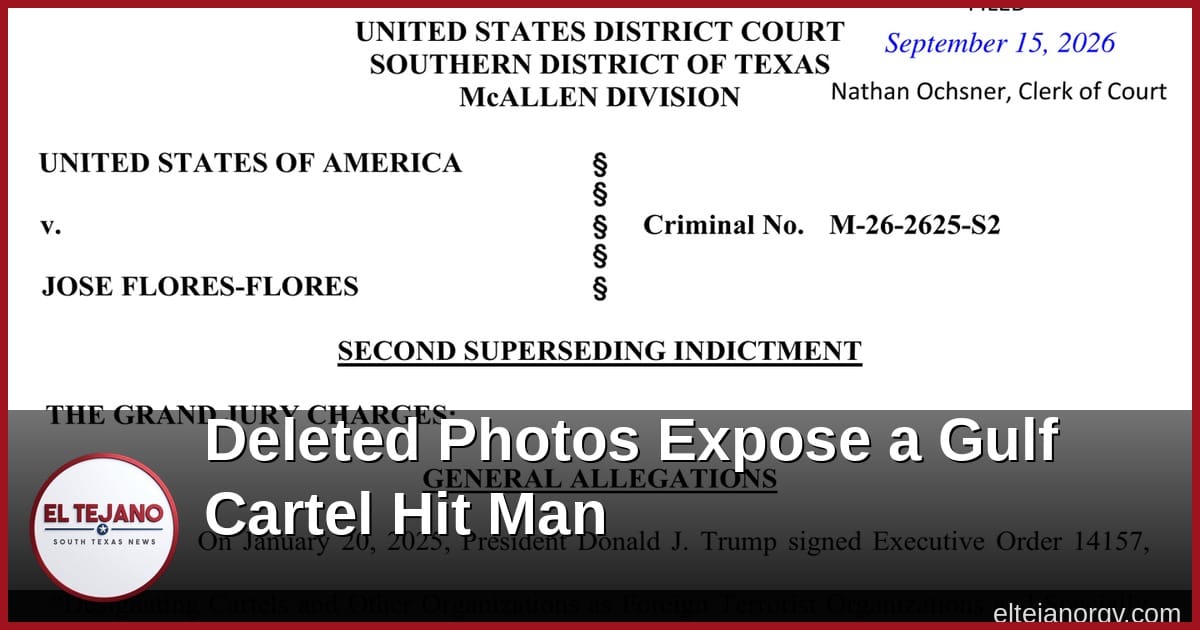
New court papers add grim new details. They came out this week in the case of Jose Flores-Flores, 21. Agents say he did more than cross the border. They say his phone proved he helped cut up a body for the Gulf Cartel.
Border Patrol caught Flores-Flores on July 10. It happened near Mission, Texas. He had just crossed the Rio Grande. Records show he is a Mexican citizen.
Agents checked his record. They found he had crossed before. Agents caught him near McAllen back in January 2025 too. He was convicted of illegal entry that time. That charge is for crossing with no papers. He was sent back to Mexico.
This time was different. Flores-Flores told agents he was in the Gulf Cartel. Agents also call the group CDG. He let agents search his phone.
Agents opened a folder of deleted photos. Inside, they say, was a video. It shows Flores-Flores cutting the arms off a dead man. He used a hand saw. The man's legs were already gone. Agents also found a photo. It showed a pile of body parts. At least two bodies had been cut apart. One more photo showed a burning barrel. Other photos showed Flores-Flores holding a radio and rifles.
Phone records show when the video was made. The date was June 26, 2026. The place was near Reynosa. That was two weeks before agents caught him.
Flores-Flores agreed to talk to agents. He gave up his right to stay quiet. He said his job was "barber and hitman." He said he worked as a hit man for a year. His job was to guard cartel turf, he said. That meant stopping theft. It meant stopping extortion, or threats for money. It meant stopping kidnapping too.
Agents showed him the video. He admitted it was him. He said the men in the video broke cartel rules. He said they had extorted stores. He said they sold drugs. He said they kidnapped people the cartel did not know about. He said he sawed off the arms for a reason. It made the body burn easier in the barrel. He said it happened outside Reynosa, Mexico, just across the river.
He later talked to an FBI agent too. He waived his rights again. He said he worked mostly at night. He worked in a Gulf Cartel area of Reynosa. He said he drove around and listened to a radio. He watched for Mexican soldiers and police. The cartel gave him a rifle, he said. It gave him body armor and a car too. If someone gave him a name or a photo, he said, he would go find that person. "I grab him and then I just deliver him," he said.
He told agents he knew one thing. He knew the government called the Gulf Cartel a terror group.
That terror list is new. President Trump signed an order in January 2025. It treats violent drug cartels like terror groups. The State Department acted a month later. It put the Gulf Cartel on the list, along with other cartels.
Court papers describe the Gulf Cartel. They call it a violent group based in northeast Mexico. It runs drug routes. It runs kidnappings and extortion too. It charges other traffickers a "tax." That tax lets them move drugs through its turf. The cartel also moves its own cocaine. It works with suppliers in Colombia. The cartel uses hit men, called sicarios. They guard cartel turf. They also keep witnesses quiet, court papers say.
A grand jury charged Flores-Flores with two counts. Both are for giving help to a terror group. Court papers call this "material support." It is a federal crime to help a terror group. The help can be cash. It can also be hands-on work. That is true once you know what the group is. One count covers the work he is accused of doing himself. The other count covers agreeing with others to do it. Each count carries up to 20 years in prison. If the cartel's acts caused a death, the law allows life in prison.
He also faces one more charge. It is for crossing the border again after his 2025 conviction.
A judge held Flores-Flores without bond after his July arrest. The judge called him a flight risk. That means the judge feared he would run, not show up for trial. He has a federal public defender. Her name is Michelle Taylor. He goes back to court on September 24.
Everyone is presumed innocent until proved otherwise.