This is an update to a story El Tejano first reported on August 23. You can read that earlier report here: https://www.eltejanorgv.com/screwworm-outbreak-halts-pet-transports-out-of-texas/
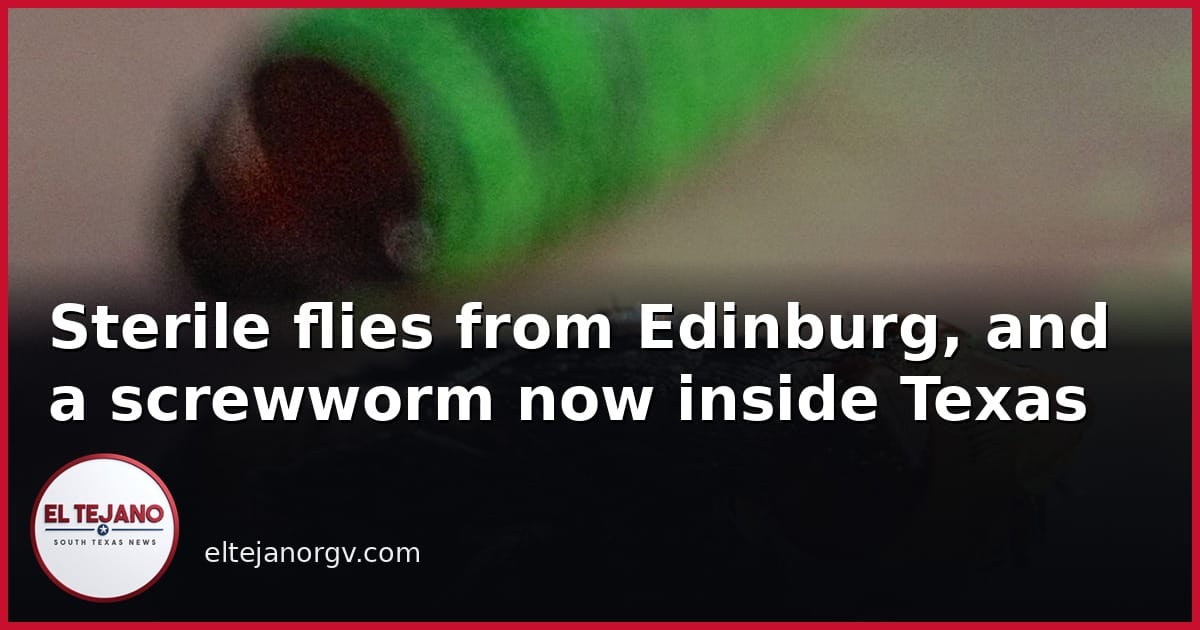
The flesh eating screwworm is no longer just a threat from Mexico. It is here.
The Texas Animal Health Commission says 16 Texas counties have cases. The state agency counts 38 ranches and homes with cases. Starr County is on that list. So are Jim Hogg and Zapata. So are counties far to the north, like Crockett and Schleicher.
Here is what the bug does. A fly lays eggs in a small cut. The eggs hatch into worms. The worms eat into live flesh. The wound gets bigger. More flies come to it. An animal can die in days if no one treats it.
It hits cattle, horses, goats, sheep, deer, dogs and cats. It can hit people too.
The main tool against it sounds odd. The tool is more flies.
USDA raises screwworm flies and makes them sterile. Sterile means they cannot have young. Crews then drop those flies from planes. Wild females mate with them. No young are born. Keep that up long enough and the bug dies out. That is how Texas beat the screwworm the last time.
The Valley now sits at the center of that work.
USDA built a fly drop center at Moore Air Base in Edinburg. That is in Hidalgo County. APHIS lists the center as up and running. It can send out up to 100 million sterile flies a week.
USDA said the drop center was done on February 9. Agriculture Secretary Brooke Rollins said, "This sterile fly dispersal facility was a high priority project, and our team delivered it in record time."
A much bigger plant is going up at the same base. It will raise the flies here at home. USDA broke ground on April 17. The cost is $750 million. USDA says it will be the only plant of its kind in the country.
The plant will start slow. USDA says the first flies come in November 2027. That first run is 100 million flies a week. At full speed it makes 300 million a week.
Rollins said at that groundbreaking, "Breaking ground on this facility marks a major investment in safeguarding America's livestock and the producers who feed this nation."
Now the second front in this fight. Horses.
USDA shut the border to cattle and horse trade in July 2025. That order is still on. So a horse cannot legally cross from Mexico right now.
Legal crossings were never simple. APHIS rules call for a 7 day hold at an approved pen. A vet must check the horse for screwworm within a day of the trip. The horse gets a shot of ivermectin, a worm drug, 3 to 5 days before it leaves. Open cuts get dusted with a bug killer.
Smuggled horses skip all of it.
The Presidio County Sheriff's Department says it has stopped more than 50 smuggled horses in the past two years. Deputies caught six near Redford in May. Sergeant Deputy Sheriff Jaime Sanchez said a smuggled horse can bring at least $30,000 on the black market. Smugglers skip the papers, the taxes and the vet check.
USDA Inspector General John Walk said the smuggling looks worse now than before. He called animal trafficking both a farm problem and a national security problem. He said a smuggled animal can be a vector. A vector is a living thing that carries a pest from place to place.
Oscar Rico studies this at the National Autonomous University of Mexico. He said, "These kinds of movements represent a risk because they allow the fly to travel much faster than it could move naturally."
Mexico's animal health agency, Senasica, has logged more than 2,000 screwworm cases in horses since 2024.
The first case in this country came on June 3. USDA found it in a calf in Zavala County. The calf was three weeks old. The worms were in its belly button.
Five days later USDA named two more. One was a calf in La Salle County. One was a dog in Andrews County. Early word was that the dog had just been in Mexico.
Under Secretary Dudley Hoskins said, "Over the past week, USDA has identified and expeditiously confronted four confirmed detections of New World screwworm."
There is some good news. On August 31 APHIS lifted two zones. One covered parts of La Salle and Webb counties. One covered parts of Gillespie, Kerr and Kimble counties. Both met the rules to reopen. Animals can move there again.
Hoskins said, "Thanks to this strong federal-state partnership, we've been able to identify cases early, respond aggressively, and slow the spread of NWS."
Other zones are still shut.
The rules are strict inside a zone. The state agency says no warm blooded animal may leave without its OK. That covers cows, horses, goats, dogs and cats. Horses and cattle need a check by a trained inspector. The inspector writes a movement paper. It lists the drug used and the animal's ID.
Ranch families can do a few things right now. Look at your animals often. Check every cut for flies, eggs or worms. Watch for a bad smell or for drainage. Call your vet fast if you see it.
The state agency takes calls at 512-714-1936 and 1-800-550-8242. The Texas Department of Agriculture takes calls at 1-800-TELL-TDA.
Texas Agriculture Commissioner Sid Miller warned about all this in the spring. Mexico found the bug in Coahuila on May 1. Miller said, "This screwworm detection in Coahuila is a serious wake-up call. New World screwworm has now been found only 119 miles from the Texas border."
Four months later the bug was in Starr County.
The Valley now has two jobs in this fight. It is a place the bug can hurt. It is also the place the cure gets built.