Everett Blomstrom is about 2 years old. Fewer than 50 people on Earth are known to have what he has.
The Travis County boy was born early, at 31 weeks. He spent 143 days in the hospital. That is where doctors found the problem. A gene called HK1 came out wrong.
HK1 makes an enzyme. An enzyme is a tiny worker inside the body. This one helps cells use sugar. It is supposed to switch on and off. Everett's never switches off.
"It's all gas, no brakes," his mother, Marissa Blomstrom, told KXAN in Austin.
The engine never stops. Acid builds up in his body. The buildup hurts his brain.
"His HK1 is always running. This results in buildup of lactic acid," said Rodney Bowling. He is the chief science officer at AlphaRose Rare Labs in Austin.
Bowling put it another way. He said to picture an engine sitting in idle but revved to 10,000 RPM. Nothing lasts long like that. "And this is the state of Everett. This is the state of his brain," he said.
Experts have a name for where this road ends. They call it childhood dementia. The brain slowly loses what it built. About half the kids with a mutation like his do not live past age 8, doctors said.
Everett has multiple seizures a day. He is on his seventh seizure medicine. He has a hard time breathing. He eats through a tube in his stomach. He has gone to the ER by ambulance and by helicopter.
Marissa holds him most of the day. She reads to him in the living room. Her mom moved down from Minnesota to help before he was born. Grandma does the chores now.
"We have a lot of really tough days," Marissa said.
Then a doctor at Dell Children's gave her a name. Rare Labs. It is part of a company called AlphaRose Therapeutics. It builds drugs for one patient at a time.
It is not a big drug company. It rents lab space at Austin Community College. A father started it while trying to save his own daughter.
"We are a preclinical drug discovery lab working in genetic disease that affects hundreds of millions of patients," said Justin Finck, the president of Rare Labs. Many big companies skip rare diseases, he said, because of what it costs to make a drug.
Here is the plan for Everett. Genes send messages. The messages tell the body what to make. Everett's gene sends a bad one. Bowling wants to go into the DNA and stop that message. Then the body would never build the harmful thing the message asks for.
If it works, his symptoms could ease and he could survive. That is what Bowling hopes.
This kind of drug has a name. Doctors call it an N of 1 trial. The N is the number of patients. One. The drug is made for one boy and nobody else.
"This is a 1 in 10,000,000,000,000 drug. This drug will help one person," Bowling said.
That is also why it costs so much. A normal drug is made for thousands of people. They all share the bill. Everett's drug is made for one boy. There is nobody to share the bill with. KXAN reported the load of raising the money falls mostly on the family.
The price could reach $3 million, Marissa said. Researchers think the drug could be ready in about two years.
Two years is fast for medicine. It is a long time for a boy whose brain is slipping.
"I just can't have money be the reason that we don't try and save Everett," Marissa said.
Bowling knows what he is asking of families. He said almost every family with a sick child like this has already spent every last dime. "I wish we could do this for free," he said.
So he keeps it lean. A small team. Robots and computers that run tests fast. Rented space instead of a fancy building.
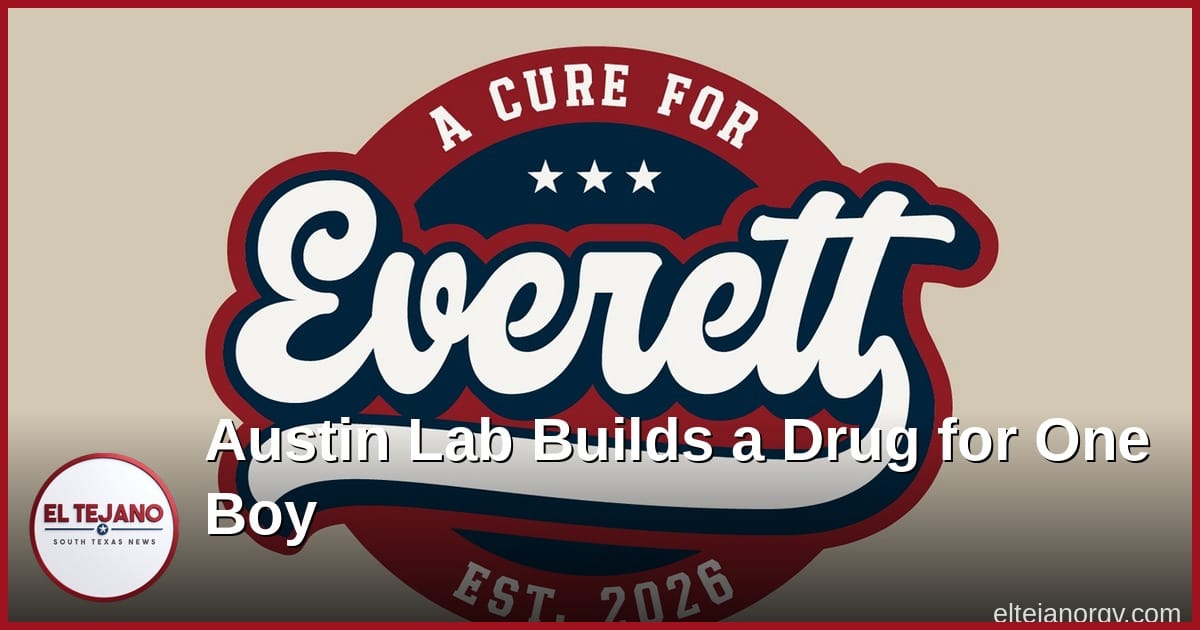
Marissa turned to social media. She calls her group Team Everett. Another rare disease mom told her that was how she raised the millions her own child needed. The family also teamed up with a nonprofit so gifts can be tax deductible. The effort is called A Cure for Everett.
Everett almost never leaves the house. His immune system is weak. He goes out for doctor visits.
Rare Labs says it has already found eight possible treatments for rare diseases. Scientists said the work on Everett could help other families too.
"Every time we go down this trail... it starts as a rabbit path and ends up as a superhighway," Bowling said.
Marissa is not asking for a miracle. She is asking for a shot.
"$3 million is a lot of money. It's a lot of money, but the science is there," she said.