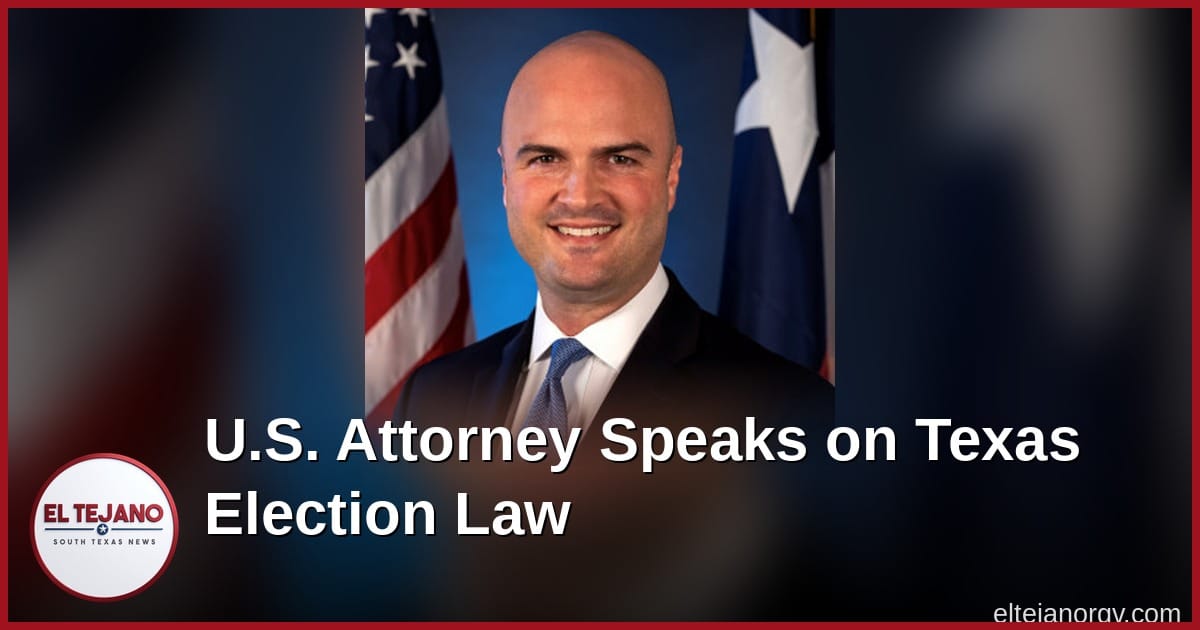
Early voting began Monday in Texas. That same day, U.S. Attorney Aaron Reitz put out a video about the vote. His office covers the Southern District of Texas. He says it runs "from Houston, down the Gulf Coast, to the Rio Grande Valley."
This was his message. "If you violate federal election law, I will hunt you down and prosecute you," Reitz said.
Here is what he said. Here is what he did not say.
Reitz named three steps. First, he appointed civil and criminal lawyers. He calls them District Election Officers. They will work with the Justice Department's Civil Rights Division. They will "assist and advise teams of election monitors at key polling locations."
Reitz described them. "They are not armed agents; they're lawyers, and the Justice Department has been doing this for decades," he said.
Second, he said his office set up rules with two Texas offices. They are the Secretary of State and the Attorney General. The aim is to look into credible reports of broken federal laws.
Third, he said his office worked with Homeland Security, the FBI and the Civil Rights Division. The aim is to send legal help where it is needed most.
Reitz said state and local officials run elections. He said voters with a complaint should go to them first. He called his own role a "backstop." He said he does not run elections. His job is to see that federal law is followed.
He said that means "only eligible voters can vote." He listed "no barred felons, no aliens, and no foreigners." He also named foreign influence and fraud. He named "crooked local election administrators" too.
What does federal law say? One law makes it a crime for a noncitizen to vote in a federal election. The penalty is a fine, up to a year in prison, or both. It has a few narrow exceptions.
Another federal law bars lying on purpose to qualify to vote. It covers your name, your address and how long you have lived in your district. It also bars paying or taking money to register or vote. The penalty is up to $10,000, up to five years in prison, or both.
The same law says no one may "intimidate, threaten, or coerce" a person for voting or trying to vote. It applies to anyone.
What the statement does not say. It names no case, no person and no probe. It names no county or polling place. It does not say which places count as "key." It gives no proof of a problem in this vote.
Where can voters take a complaint? The Texas Secretary of State lists 1-800-252-8683 to report a possible voting rights abuse. That spells 1-800-252-VOTE. You can also take it to your local election official.
Early voting runs through Friday, Oct. 30. Election Day is Tuesday, Nov. 3. You can vote at any early voting site in your county. Bring a photo ID. The state lists seven kinds. Two are a Texas driver license and a U.S. passport.