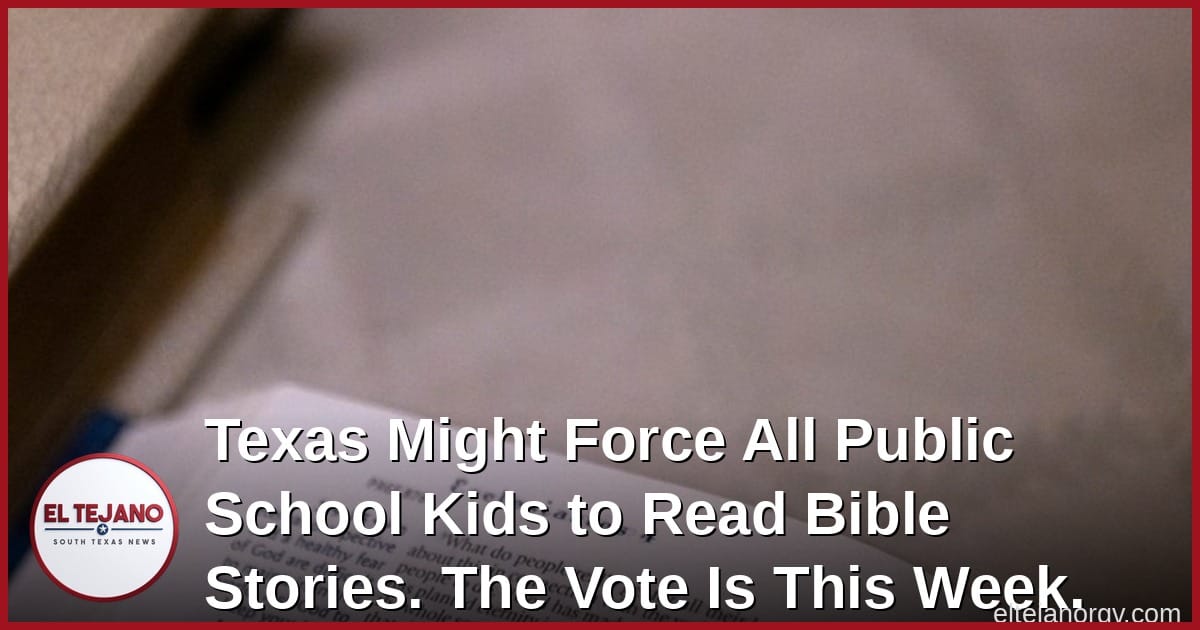
Texas may make every public school kid read Bible stories. Kindergarten through 12th grade. The State Board of Education meets in Austin this week. A final vote comes by June 26.
If it passes, the new rules start in 2030.
The board first approved the list in April. It includes about a dozen Bible passages mixed into English class. Kids as young as 6 would read "Noah's Ark" and "David and Goliath" from picture books. Fourth-graders would read words of Jesus from the Gospel of Luke. High schoolers would read the Adam and Eve story from Genesis.
One required book -- "Daniel and the Lion's Den" -- comes from the Christian Broadcasting Network. That is a TV ministry started by preacher Pat Robertson.
All the Bible versions on the list are Protestant. The state picked the New International Readers Version, the King James Bible, and the English Standard Version. None are Catholic. The list pulls from both the Old and New Testament. Nothing from the Quran, the Torah, or any other faith.
This matters in South Texas. Most families here are Catholic. The King James Bible was built for the Protestant church. A professor at UT Austin pointed out that Catholic parents in the past created their own private schools. They did not want their kids taught from Protestant Bibles in public school.
"Any time compulsory religion happens in public education, it's going to lead to divisiveness," said Chad Seales, a religion professor at UT.
Some passages on the list carry a hard history. The Exodus story was once used to defend slavery. It was used to push Native Americans off their land. A Harvard professor said teachers would need to address all of that. The new rules offer no guidance on how.
Critics say the list goes too far.
"There really isn't a good justification for trying to turn our public schools into Sunday schools," said board member Rebecca Bell-Metereau.
Board member Gustavo Reveles said he worries about kids being pushed into one faith. He called the move "very troublesome" and said the separation of church and state "is a valuable one for our country."
Supporters say it helps students understand history and values.
"When students engage directly with foundational texts, they develop a deeper understanding of the principles that shaped the USA and Texas," said board member Julie Pickren.
The vote is this week. If the board says yes, the rules take effect in 2030.