
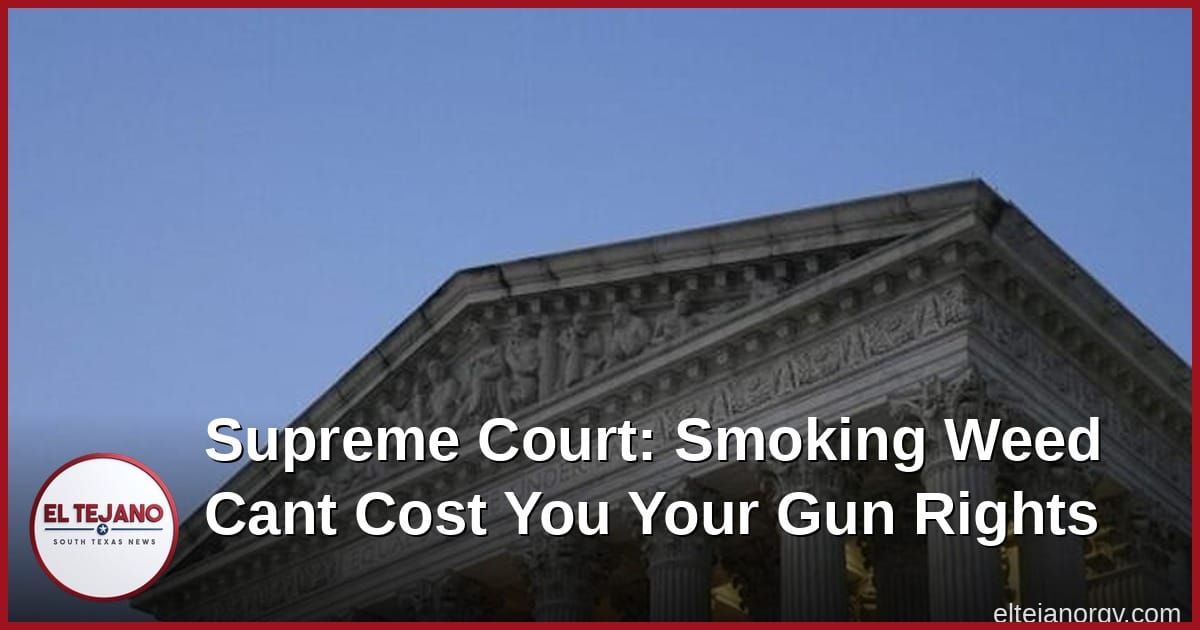
The U.S. Supreme Court ruled Thursday that the federal government cannot take away a person's gun rights just for smoking marijuana.
All nine justices agreed. The vote was 9-0.
The case started with a Texas man named Ali Hemani. He told FBI agents he smoked pot a few times a week. He also owned a gun he had bought legally. The feds charged him under a law that makes it a crime to own a gun while using illegal drugs. That crime carries up to 15 years in prison.
Hemani fought the charge. His case went all the way to the highest court in the country.
Justice Neil Gorsuch wrote the ruling. He said the government went too far. Marijuana is now legal in some form in 40 states. The feds themselves moved it off the most dangerous drug list. Gorsuch said those facts matter. You can't lose your gun over pot, he wrote.
The court said the government cannot take away a person's gun rights just because they smoke pot.
This ruling hits close to home in South Texas. Many people here have marijuana on their record. Gun ownership is common across the Rio Grande Valley. Under the old reading of the law, having weed and a gun at the same time was a federal crime, even when done legally under state law.
The ruling is not a free pass. Federal law still bans people who use harder drugs from owning guns. Police can still make arrests for other gun and drug charges. But the court said marijuana use alone is not enough to take away gun rights.
Some people called it a big win.
Stephen Stamboulieh is a lawyer for Gun Owners of America. "I think it's a pretty significant win when we have basically the entire court saying that a federal statute can't go as far as it tried to go," he said.
Others saw it as a narrow call. Eric Ruben teaches law at SMU in Dallas. He said the court saw it plainly. "I think the outcome of this case was based on the view that most Americans may hold, which is that weed is the new booze," he said.
The same law was used to charge Hunter Biden, son of former President Joe Biden. Hunter Biden was found guilty under it. His father pardoned him before he went to prison. Thursday's ruling may not have helped him anyway. He was also charged with using harder drugs, not just marijuana.
The justices did not all agree on the reason for the ruling. Five of them wrote extra opinions with different ideas about where to draw the line on guns and drug use. That tells you this fight is not over. More court cases on this topic are coming.
The Supreme Court changed the rules on gun laws in 2022. It said any gun law must match rules from when the country was born, back in the 1700s and 1800s. That has been hard to apply. Courts have fought over it ever since. Thursday's case is part of that same battle.
The law Hemani was charged under is still in place. It still applies to people who use harder drugs and own guns. The court only said it went too far when used against marijuana users.
For South Texans who use marijuana and own guns, Thursday's ruling gives a little more protection. But the law is still being worked out in courts across the country. More fights are ahead.