
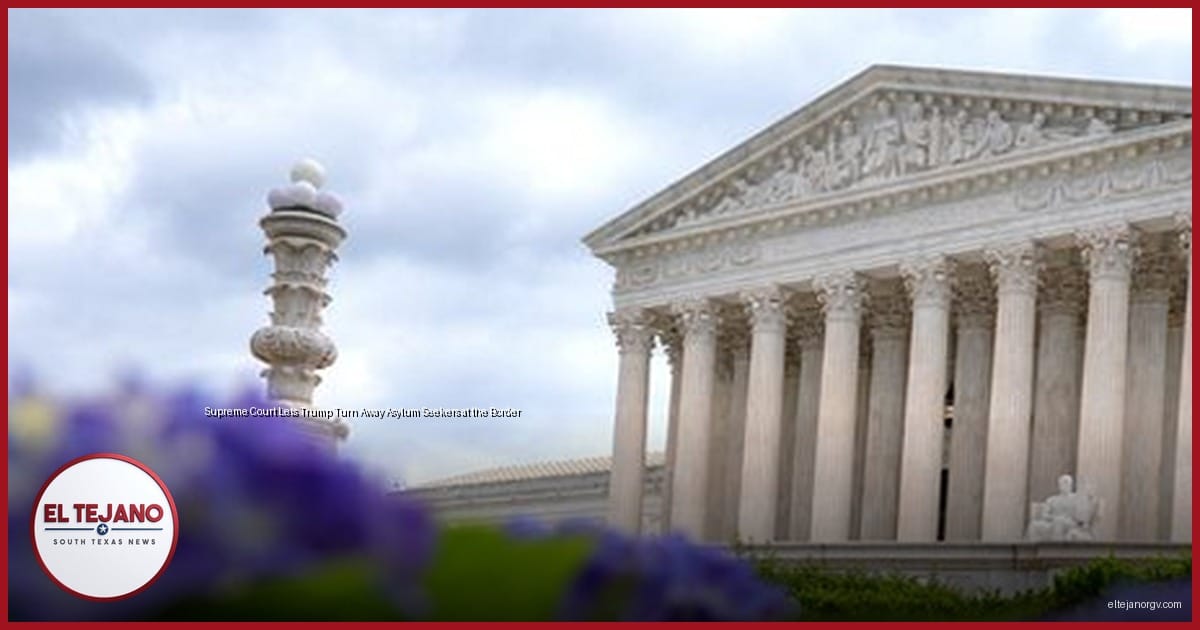
The Supreme Court sided with Trump on Thursday. The vote was 6 to 3. The court said the government can turn migrants away right at the border before they ask for asylum.
The policy has a name: metering. Under metering, border agents set a daily cap on how many people can enter and ask for protection. People sent back must wait in Mexico. Some wait days. Some wait weeks, in places that are often not safe.
South Texas could feel this fast. Starr County, Hidalgo County, and Webb County sit right on the border. They have some of the busiest crossings in the country. If metering comes back, families who show up could be turned away before they talk to any officer.
The DHS has not said if it will bring metering back. But DHS lawyer James Percival praised the court. "This decision opens up an important tool to continue securing our southern border," he said.
This policy is not new. President Obama's team first used it at the San Diego crossing. Many Haitians were coming in from Tijuana at the time. Trump later used it at every border crossing during his first term. Biden ended it in 2021. A federal judge in California said it broke the law. The Supreme Court reversed that on Thursday.
Justice Samuel Alito wrote for the court's six conservatives. He said people stopped on the Mexico side of the border have not yet arrived in the U.S. under the law. So the law giving them the right to ask for asylum does not apply.
"A guest does not arrive in a house when he knocks on the front door," Alito wrote.
Justice Sonia Sotomayor fought back hard. She read her dissent out loud from the bench. Judges almost never do that. It shows very strong anger. Justices Elena Kagan and Ketanji Brown Jackson stood with her.
"More people will die," Sotomayor wrote. "More people will attempt to cross the border illegally, and some will make it while others will not. More people will be forced to walk along the U.S.-Mexico border in dangerous conditions."
She also said the ruling "regrettably and tragically extinguishes the light of the torch of the Statue of Liberty." Her point was that the court just closed the door on people who need help most.
Alito spoke from the bench right after. He pointed out both Obama and Trump had used metering. That kind of back-and-forth is rare for the Supreme Court.
Under U.S. law, anyone who steps on American soil can ask for asylum. To qualify, a person must show real danger back home. The danger must be tied to their race, faith, home country, political views, or a group they belong to. People who are approved can stay. They can work, bring family, and one day become a citizen.
The groups that filed the case were upset. Al Otro Lado is an immigrant rights group. Its director said the ruling leaves the most at-risk people with no help. "This is sure to result in many more lives lost," she said.
Democracy Forward also backed the case. Its leader, CEO Skye Perryman, called for people to speak up. "We call on all Americans to demand that our government protect the families the Court today decided to keep in harm's way," she said.
That same day, the court also ruled Trump can end a program called TPS. That program lets Haitians and Syrians stay in the U.S. without fear of being sent home. Their home countries are in crisis. Many people in the Rio Grande Valley are on TPS.
The court is finishing its term this week. DHS has not set a date for when or if metering will restart. Advocates say they will keep fighting. More updates are expected soon.